Research
My research explores how minds evolve, how cooperation emerges, and why humans think the way we do. I am especially interested in what we have in common with other social species on this planet, and what makes us distinctive.
I was awarded the 2018 Leverhulme Prize for my research and have published more than 90 articles in international, peer-reviewed journals. A full publication list can be found on my Google Scholar page.
Cooperation and conflict in family groups
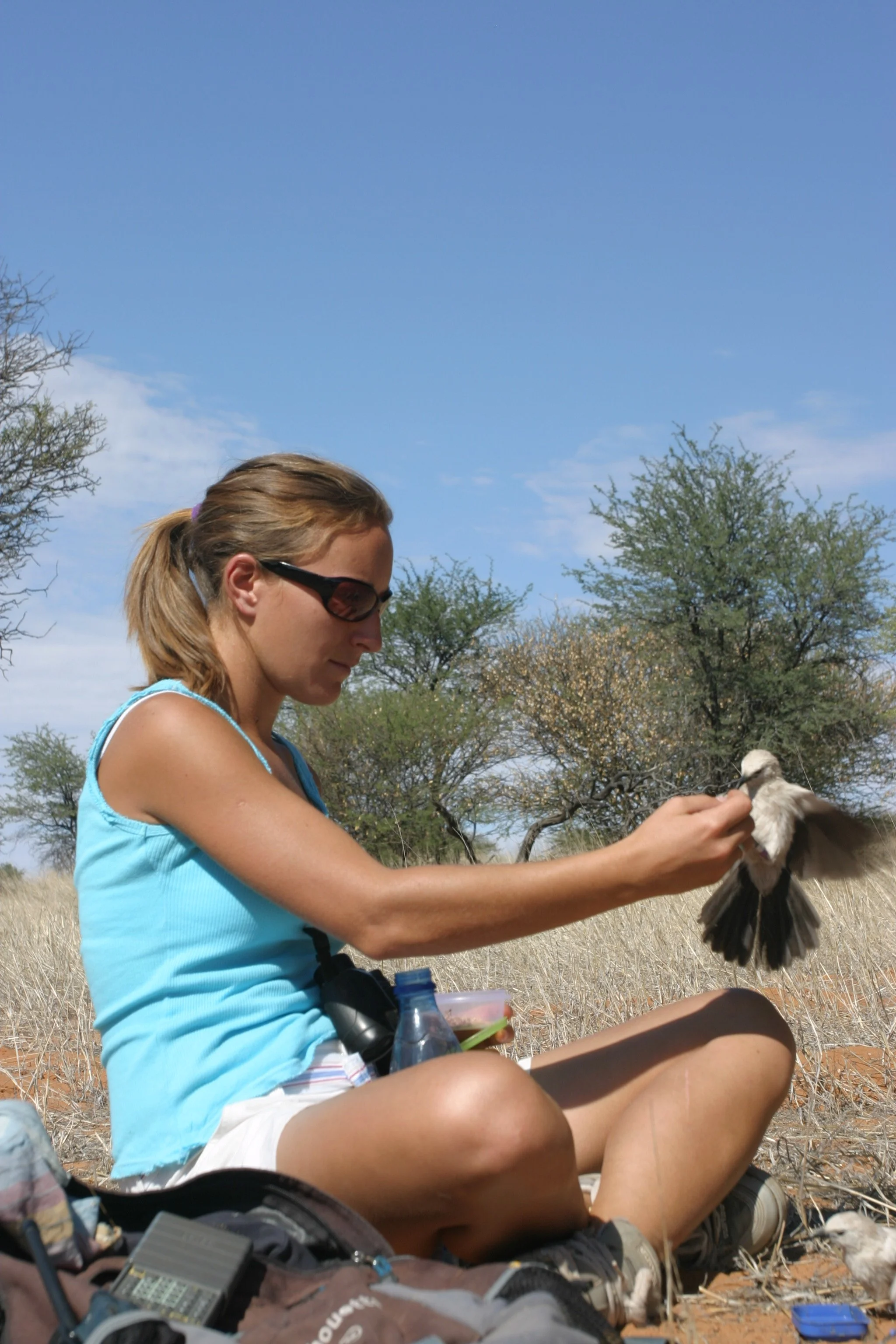
Pied babblers are highly social birds that live in the Kalahari Desert. Their unusual “cooperative” breeding system means that only the dominant male and female reproduce, while other group members help to raise these offspring.
This poses an evolutionary puzzle: why invest time and energy helping others to reproduce, rather than breeding yourself? My PhD research explored the conflicts that inevitably arise, and how they are resolved.
Selected publications:
Raihani, N. J., & Ridley, A. R. (2008). Experimental evidence for teaching in wild pied babblers. Animal Behaviour, 75(1), 3-11.
Thornton, A., & Raihani, N. J. (2008). The evolution of teaching. Animal Behaviour, 75(6), 1823-1836.
Raihani, N. J., et al. (2010). Synchronous provisioning increases brood survival in cooperatively breeding pied babblers. Journal of Animal Ecology, 79(1), 44-52.
Cooperation among non-relatives
Cleaner wrasse are small fish that hold cleaning stations on coral reefs. They provide a vital service to their “clients” by removing harmful parasites. This sounds harmonious, but there is an underlying conflict: cleaner fish prefer to each the client’s protective mucus and scales rather than the parasites. There are no police fish to make the cleaner fish toe the line, and clients and cleaners cannot negotiate the terms of service in advance.
How, then, does cooperation emerge in this system where one party is constantly tempted to cheat, and what might that reveal about cooperation and conflict in our own species?
Selected publications:
Raihani, N. J. et al. (2010). Punishers benefit from third-party punishment in fish. Science, 327(5962), 171-171.
Raihani, N. J. et al. (2012). Male cleaner wrasses adjust punishment of female partners according to the stakes. Proceedings of the Royal Society B: Biological Sciences, 279(1727), 365-370.
Raihani, N. J. et al. (2012). Punishment and cooperation in nature. Trends in ecology & evolution, 27(5), 288-295.
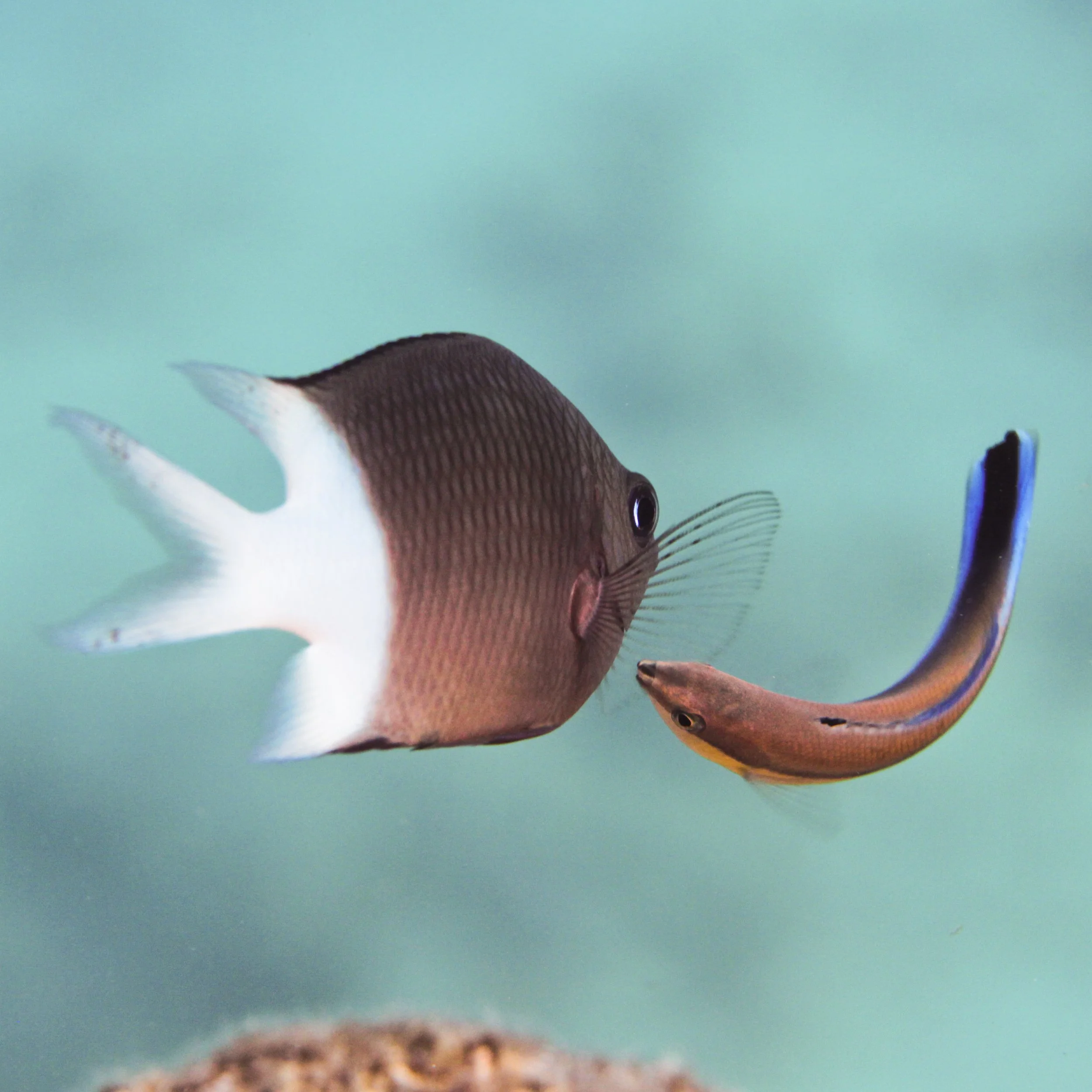
© Simon Gingins
Social behaviour in humans
My work explores the social forces that allow human societies to function, and the conditions under which cooperation begins to break down. I study how trust emerges, how social norms are established and enforced, and why people sometimes cooperate with strangers while at other times become vulnerable to division, misinformation, and conspiracy thinking.
These questions are increasingly important in a world facing collective challenges, such as climate change and pandemics, and political polarisation, where successful outcomes often depend on large-scale cooperation between unrelated individuals.
Selected publications:
Raihani, N. J., & Bshary, R. (2019). Punishment: one tool, many uses. Evolutionary Human Sciences, 1, e12.
Raihani, N. J., & Smith, S. (2015). Competitive helping in online giving. Current Biology, 25(9), 1183-1186.
Raihani, N. J., & Bell, V. (2019). An evolutionary perspective on paranoia. Nature human behaviour, 3(2), 114-121.
Greenburgh, A., & Raihani, N. J. (2022). Paranoia and conspiracy thinking. Current opinion in psychology, 47, 101362.
Melis, A. P., & Raihani, N. J. (2023). The cognitive challenges of cooperation in human and nonhuman animals. Nature Reviews Psychology, 2(9), 523-536.
Claessens, S., Atkinson, Q. D., & Raihani, N. J. (2026). Individual differences in motives for costly punishment. Communications Psychology.